

 English
 русский
 Español
 عربى

Walk into a well-run cutting room and the first thing you notice is not the saws. It is the rhythm. Carcasses arrive at a steady pace, primal cuts leave on a predictable beat, and nobody has to walk backwards to reach a knife sterilizer. That rhythm is what a meat cutting line is really designed to produce, and it is where most equipment decisions are won or lost.
We have been building meat processing machinery since 2003, and we have seen the same pattern in plants of every size: the saws get all the attention, while the quiet details — table heights, crate flow, drain positions, rail returns — decide whether the line runs smoothly at eight in the morning and still runs smoothly at four in the afternoon. This guide walks through what a cutting line actually contains, how beef and pork lines differ, and how to plan the supporting details before the first crate of meat arrives.
Content
- 1 What a Meat Cutting Line Really Includes
- 2 Walking the Line Station by Station
- 3 Cattle and Pig Lines Follow Different Rules
- 4 Throughput: The Number That Shapes Everything Else
- 5 Hygiene Belongs in the Layout, Not in the Rules
- 6 Layout Mistakes We See Most Often
- 7 Commissioning, Training and Spare Parts
What a Meat Cutting Line Really Includes
A cutting and deboning line is not a single machine. It is a sequence of workstations, transport elements and hygiene points that have to cooperate. In practice, a complete line usually contains:
- An infeed path — overhead rails, conveyors or transferring systems that move carcass sides or quarters from the chiller to the cutting area.
- Cutting stations fitted with table-type or vertical circular blade saws, depending on whether the operator works horizontally or stands to the blade.
- Deboning tables sized for the cut mix, with enough clearance for operators to move the product without crossing each other's arms.
- Container handling — crate spinning machines, stack and unstack units, and the crates themselves, which quietly absorb a surprising amount of floor space.
- Sanitation hardware: hand wash basins, knife sterilizers and a crate washer that keeps the container loop clean.
- Weighing, grading and packing surfaces, plus a route back into the chiller.
The point of listing them together is that each element constrains the next. A fast saw does nothing for you if the crates pile up behind it.
Walking the Line Station by Station
When we visit a plant, we usually ask the team to walk us through the line in production order and describe what happens at each stop. That simple exercise exposes most bottlenecks before any drawing is made.
| Station | What happens there | What to plan for |
|---|---|---|
| Carcass transfer | Sides or quarters move from the chiller to the cutting room | Straight runs, gentle curves, cleanable rail returns |
| Primary splitting | Saws divide the side into primals | Saw capacity versus hourly rate, blade change routine |
| Trimming and deboning | Operators remove bone, fat and trim | Table height, reach distances, sterilizer within arm's length |
| Weighing and packing | Cuts are graded, weighed and boxed | Label flow, data capture, conveyor capacity to the chiller |
| Container handling | Crates are tipped, stacked, returned and washed | Washer throughput, drainage, dedicated floor space |
| Cleaning | Foam, rinse and sanitize at the end of the shift | Floor slope, drain positions, removable guards |
Cattle and Pig Lines Follow Different Rules
It is tempting to treat a cutting line as species-neutral, but carcass weight, fat cover and the commercial cut mix push the design in different directions. A line built around beef primals will feel cramped the moment you try to run pork through it at the same rate.
Cattle cutting and deboning
Beef sides are heavy and the primal separation is more physically demanding, so rail capacity, transfer height and saw torque matter more than raw blade speed. Operators also need generous space at the splitting station, because a side that swings while being cut is both a quality problem and a safety problem.
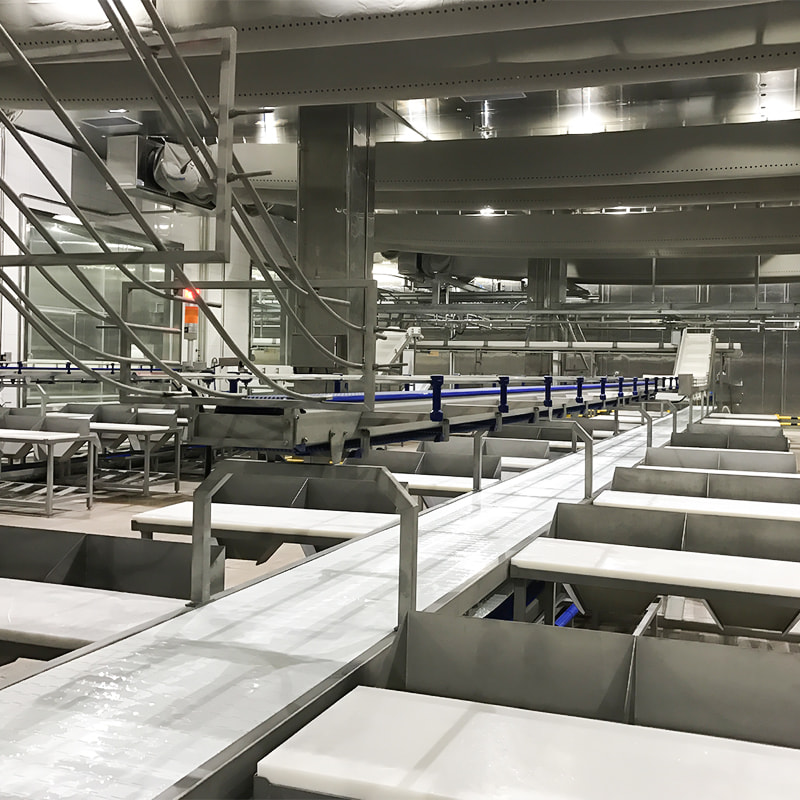 Cattle Cutting and Deboning SolutionTurnkey cattle carcass setup covering deboning, trimming and packaging, with layout design and commissioning; suited to plants weighing rail capacity and splitting-station space.View Product →
Space around the table, a stable transfer position and a clean cut line matter as much as motor size.
Pig cutting and deboning
Pork lines tend to run at higher piece rates with lighter carcasses, which shifts the emphasis toward repetition, short reaches and fast container turnaround. A pig line that has been squeezed into a room designed for lower rates usually shows it first at the crate stacking point, not at the saw.
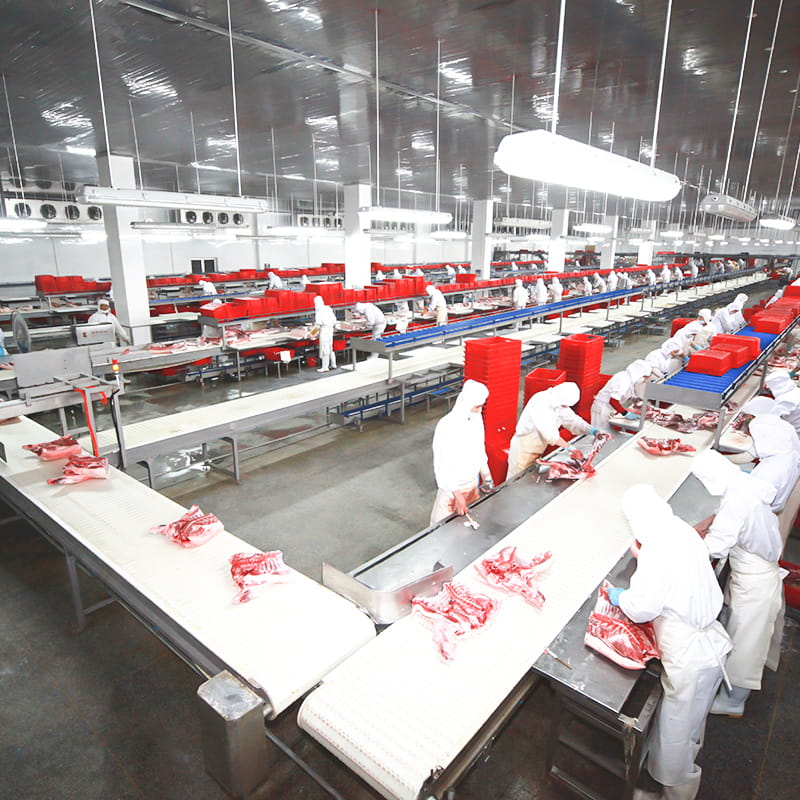 Pig Cutting and Deboning Turnkey LineTurnkey pig carcass processing across pre-cutting, deboning and packaging, with laser-guided sawing, crate conveyor lines and ergonomic platforms for high-repetition work.View Product →
Here, we would rather slow the line by five percent than accept a station where operators have to twist to reach the product.
Throughput: The Number That Shapes Everything Else
Most buyers arrive with a target figure in mind — carcasses per hour, tonnes per shift, boxes per day. That number is useful, but it is only the beginning. Before selecting equipment, we work through a short list of questions with the plant team:
- What is the realistic hourly rate across a full shift, including breaks and changeovers?
- What is the cut mix, and how often does it change during the week?
- How fast can the chiller accept finished product, and what happens when it cannot?
- How many operators will work the line, and where will they stand relative to knives, sterilizers and crates?
- Where does buffer stock live when something upstream stops?
The answers usually reveal that the binding constraint is not the saw at all, but the container loop or the packing bench. If you would like to see how these numbers play out in practice, our article on the precision and productivity of the modern meat cutting line goes deeper into the trade-offs.
Hygiene Belongs in the Layout, Not in the Rules
Every plant has a cleaning procedure. The difference between a comfortable room and a difficult one is whether hygiene was designed into the layout or added afterwards as a set of instructions.
Three details do most of the work. First, hand wash basins and knife sterilizers placed within reach of the work position, so operators do not have to leave the line to use them. Second, a dedicated container loop: crates come in dirty on one side, pass through the washer, and leave clean on the other, with no crossing path. Third, floors that slope toward drains rather than away from them.
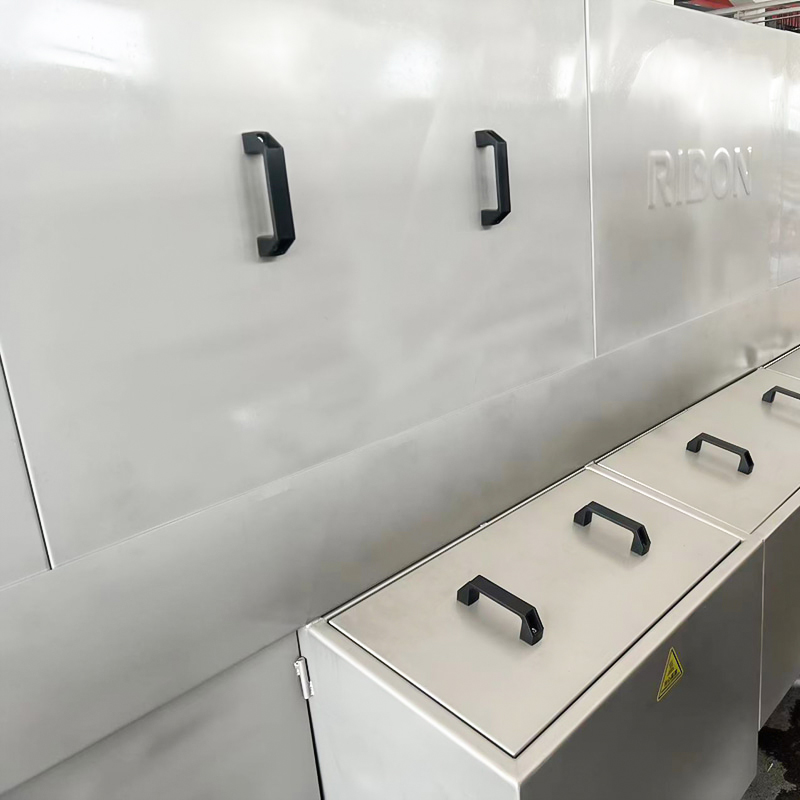 Automatic Plastic Crate Washing and Sterilization SystemAutomatic crate washer with warm-water washing, 82°C sterilization and optional drying, sized in several capacities for dedicated dirty-to-clean container loops.View Product →
The crate washer deserves more thought than it usually gets. Size it for peak return volume, not average volume, and give it enough room for the operator to load and unload without stepping into the wet zone.
Layout Mistakes We See Most Often
- Table heights set to a single average operator instead of adjusting per station.
- Rail returns routed across the main walkway, so people step around hooks all day.
- Crates staged in the cutting room because the wash area is too small.
- Saws installed before the product flow was drawn, forcing the layout to fit the machine.
- No gap between the cutting room and the packing area, so cold air and condensation become a permanent problem.
None of these are expensive to fix on paper. All of them are awkward to fix after commissioning.
Commissioning, Training and Spare Parts
The first week of operation tells you a great deal about a line. Operators find the shortcuts that the drawings did not anticipate, and maintenance teams discover which guards are annoying to remove for cleaning. We try to stay close during that period, because a small adjustment to a table or a transfer height on day three saves months of minor complaints.
Two practical suggestions from experience: keep a spare blade set and a spare motor coupling on site, and train at least two people per station. The line is only as reliable as the second person who can run it when the first one is on leave.
A meat cutting line rewards the people who plan the unglamorous parts — the crate loop, the reach distance, the drain position, the return rail. Get those right and the saws quietly do their job. Get them wrong and no amount of blade speed will recover the shift. If you are sketching out a new room or reworking an existing one, you are welcome to browse our cutting and deboning line range and talk the layout through with us before anything is ordered.