

 English
 русский
 Español
 عربى
عربى
Content
What Is a Cattle Slaughtering Line?
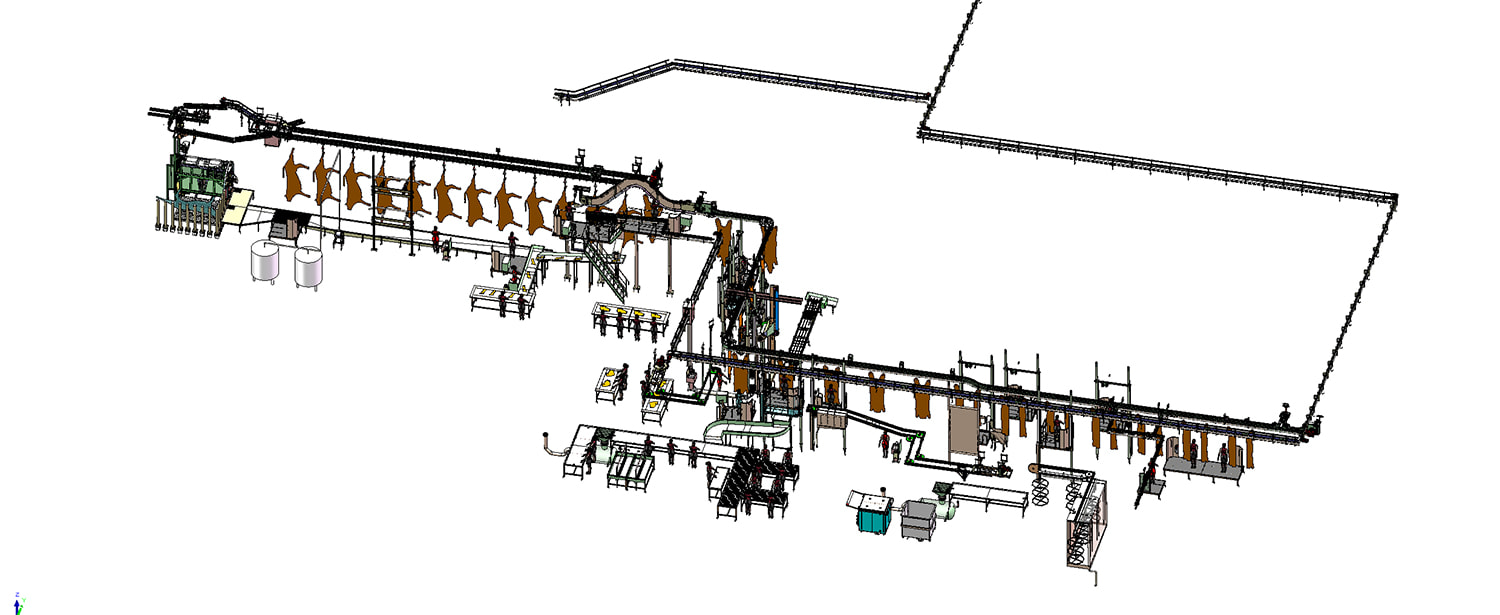
A cattle slaughtering line is a systematically arranged series of machines, conveyors, workstations, and tools that together carry out the full process of converting live cattle into dressed carcasses ready for further processing, chilling, or retail distribution. Also referred to as a beef slaughter line or bovine processing line, it is the operational backbone of any modern abattoir or beef processing plant. The line is designed to handle every sequential step — from the arrival and stunning of live animals through bleeding, skinning, evisceration, splitting, and final inspection — in a continuous, controlled, and hygienic workflow.
The concept behind a cattle slaughter line is efficiency through sequential flow. Rather than stationary processing where workers move around the animal, the carcass moves along an overhead rail system while specialized workers or automated equipment perform specific tasks at fixed stations. This approach dramatically increases throughput, reduces cross-contamination risk, and allows for precise quality and hygiene control at every step. A well-designed beef slaughtering line can process anywhere from 20 to over 400 head of cattle per hour depending on its scale, automation level, and the size of the operation.
Modern cattle slaughtering lines are engineered to comply with strict food safety regulations, animal welfare standards, and environmental requirements. Whether you're building a small regional abattoir or a large-scale industrial beef plant, understanding how these lines are structured — and what separates a well-built line from a poorly designed one — is essential for making sound investment decisions and achieving safe, efficient, and compliant operations.
The Step-by-Step Process of a Cattle Slaughter Line
Every cattle processing line follows a defined sequence of operations. Each step builds on the previous one, and the hygiene, speed, and precision at each stage directly affects the quality and safety of the final product. Here is a detailed walkthrough of the complete process:
Lairage and Animal Reception
Before any processing begins, cattle are held in lairage — holding pens at the slaughter facility — for a mandatory rest period, typically 12 to 24 hours. This rest period is critical for both animal welfare and meat quality. Stressed animals release cortisol and deplete muscle glycogen, which raises muscle pH and leads to dark, firm, dry (DFD) beef — a serious quality defect. During lairage, animals have access to water, and a trained ante-mortem veterinary inspection is conducted to identify and segregate any animals showing signs of disease, injury, or unfitness for slaughter. Only animals that pass ante-mortem inspection proceed to the slaughter line.
Stunning
Cattle are driven from lairage through a forcing pen and single-file race into a stunning box — a narrow, enclosed stall that restrains the animal for the stunning procedure. Effective stunning renders the animal immediately and irreversibly unconscious before bleeding, which is both an animal welfare requirement and a regulatory mandate in most countries. The most widely used method is penetrating captive bolt stunning, where a pneumatic or powder-actuated device fires a steel bolt into the frontal lobe of the brain. Proper positioning — aimed at the intersection of two diagonal lines drawn from the base of each horn to the opposite eye — is critical for a clean, effective stun. Some facilities, particularly those processing for halal or kosher markets, use non-penetrating captive bolt or controlled atmosphere stunning methods that comply with religious slaughter requirements.
Shackling and Hoisting
Immediately after stunning, the animal is shackled by one or both hind legs using a chain or shackle attached to the overhead rail system. A hoist — either manual or powered — lifts the stunned animal off the floor and onto the bleed rail. Speed between stunning and hoisting is critical: the window between effective stunning and the start of bleeding must be minimized — ideally under 60 seconds — to ensure the animal remains unconscious throughout the bleeding process and to maximize blood drainage from the carcass.
Bleeding (Sticking)
On the bleed rail, a skilled operator performs the sticking cut — severing the major blood vessels at the base of the neck (the carotid arteries and jugular veins) with a long, sharp sticking knife. The carcass is typically enclosed in a bleeding cabinet or positioned over a drainage trough to collect blood, which may be recovered for rendering, pharmaceutical use, or blood meal production. Cattle are bled for a minimum of three to five minutes. Incomplete bleeding is one of the most common causes of poor carcass appearance, resulting in dark, blood-stained meat. In halal slaughter, the sticking cut must sever all specified vessels in a single, swift motion while the animal faces the qiblah — and the procedure must be performed by a trained Muslim slaughterman with the appropriate blessing.
Head Removal and Hide Removal (Skinning)
After bleeding, the head is removed at the atlas joint and transferred to a dedicated head inspection rack, where it undergoes post-mortem veterinary inspection for signs of disease, particularly tuberculosis lymph node examination. The head remains identified with the carcass throughout inspection. Skinning — removing the hide — follows, proceeding in a defined sequence from lower legs to the body. Modern cattle slaughter lines use a combination of manual knife work at the legs, belly, and back, followed by a mechanical hide puller that strips the hide from the carcass in a single downward pull. Hide pullers significantly reduce the risk of contaminating the carcass with hide bacteria and reduce labor requirements compared to fully manual skinning.
Evisceration
Evisceration — removal of the internal organs — is one of the most hygiene-critical steps on the entire slaughter line. The abdominal and thoracic cavities are opened and the gastrointestinal tract, stomach, intestines, liver, lungs, heart, and other organs are removed. Strict protocols are followed to prevent gut contents from contaminating the carcass: the bung (rectum) is tied off before removal, and the esophagus is clamped or sealed before the stomach is cut free. Organs destined for human consumption (offal such as liver, heart, and tongue) are placed on a dedicated viscera inspection trolley that travels alongside the carcass, maintaining the identity link required for post-mortem inspection. Any contamination of the carcass with gut contents or fecal material at this stage requires immediate trimming and decontamination.
Splitting
After evisceration, the carcass is split longitudinally along the vertebral column into two halves (sides) using a powered band saw or reciprocating splitting saw. The split must follow the exact center of the spinal column to produce symmetrical sides and to facilitate spinal cord removal — a mandatory step in many countries as part of specified risk material (SRM) controls for bovine spongiform encephalopathy (BSE). The spinal cord, along with the skull, vertebral column, and other specified tissues from older animals, is classified as SRM and must be removed and disposed of under strict regulatory controls in BSE-risk regions.
Post-Mortem Inspection, Trimming, and Washing
Carcass halves proceed to the post-mortem inspection station, where a government-authorized veterinarian or meat inspector examines the carcass, organs, and head for any signs of disease, pathology, or contamination. Passed carcasses may then undergo trimming to remove any visible contamination, bruising, or SRM material, followed by a final high-pressure water wash to remove bone dust, surface bacteria, and any remaining contamination. Some facilities also apply antimicrobial interventions such as organic acid sprays (lactic acid or acetic acid) at this stage to reduce surface bacterial loads and extend shelf life — a practice that is standard in the United States but regulated differently in the EU.
Weighing, Grading, and Chilling
Inspected and washed carcass halves are weighed on an in-line rail scale and may be graded for quality and yield classification (USDA Prime/Choice/Select in the US, or EU classification systems in Europe). Carcasses are then transferred to chilling rooms where they are cooled to an internal temperature below 7°C (45°F) within a defined timeframe — typically within 24 to 36 hours for large bovine carcasses. Rapid and uniform chilling is critical for food safety, tenderness development, and shelf life. Blast chilling tunnels and carefully controlled airflow patterns are used in high-throughput plants to achieve compliant chilling rates.
Core Equipment in a Cattle Slaughter Line
A complete cattle beef processing line incorporates a wide range of specialized equipment. The quality, design, and maintenance of each piece of equipment directly affects throughput, hygiene, worker safety, and carcass quality. Here is a breakdown of the essential equipment categories:
| Equipment | Function | Key Feature to Evaluate |
| Stunning Box | Restrains animal for stunning | Animal welfare design, ease of cleaning |
| Captive Bolt Stunner | Renders animal unconscious | Penetration depth, maintenance reliability |
| Hoist and Transfer System | Lifts carcass onto bleed rail | Lifting capacity, speed, safety features |
| Overhead Rail System | Moves carcass through all stations | Rail gauge, load rating, corrosion resistance |
| Bleeding Cabinet / Trough | Collects blood during bleeding | Blood recovery efficiency, drainage design |
| Hide Puller | Mechanically removes hide | Pulling force, carcass contamination control |
| Evisceration Platform | Height-adjustable worker platform for organ removal | Ergonomics, hygiene, adjustability range |
| Viscera Inspection Trolley | Holds organs alongside carcass for inspection | Identity tracking, ease of sanitization |
| Carcass Splitting Saw | Splits carcass along vertebral column | Blade type, cut precision, SRM control |
| High-Pressure Carcass Washer | Final surface decontamination wash | Water pressure, coverage, water recycling |
| In-Line Rail Scale | Weighs carcass halves automatically | Accuracy, data integration with plant management system |
| Knife Sterilization Units | Sanitizes knives between cuts | Water temperature (minimum 82°C), flow rate |
Hygiene and Food Safety Design Principles
Hygiene is the single most important design criterion in a cattle slaughter line. Every structural, equipment, and workflow decision must prioritize the prevention of microbiological contamination of carcasses and the facilitation of effective cleaning and sanitization. The following principles are fundamental to hygienic slaughter line design:
- Clean/dirty flow separation: The line must be physically designed so that the clean carcass side never crosses paths with dirty areas such as the hide removal zone, stomach and intestine handling areas, or waste disposal routes. In a well-designed plant, airflow, personnel movement, and material flow all follow a strict clean-to-dirty direction.
- Stainless steel construction: All surfaces, equipment frames, rails, platforms, and conveyors that may contact carcasses or be exposed to blood, water, or steam must be constructed from food-grade stainless steel (typically 304 or 316 grade). Stainless steel resists corrosion, tolerates chemical sanitizers, and has no surface porosity for bacterial harborage.
- Knife hygiene stations: Multiple knife sterilization units — containing water maintained at a minimum of 82°C (180°F) — must be positioned throughout the line so that operators can sterilize their knives between every carcass. This is a regulatory requirement in most jurisdictions and the primary control for preventing cross-contamination between animals.
- Zero carcass-floor contact policy: Once a carcass is hoisted onto the overhead rail, it must never touch the floor, walls, or any non-sanitized surface again. Rail height, platform design, and equipment positioning must all be engineered to guarantee this throughout every processing step.
- Drainage and water management: Floors must be sloped (minimum 2%) toward drainage channels, with adequate drain capacity to handle peak water flow during operations and cleaning. Drainage systems must prevent water from flowing from dirty to clean zones.
- Ante-mortem and post-mortem inspection integration: The line layout must provide dedicated, well-lit inspection stations with adequate access for the official veterinarian to examine carcasses, heads, and viscera systematically without interrupting line flow.
Throughput Capacity and Line Speed Planning
Getting the capacity and speed of a cattle slaughter line right is one of the most consequential engineering decisions in plant design. A line that's too slow leaves capacity and profitability on the table; one that's too fast creates food safety risks, animal welfare violations, and worker injuries. Here is how to think about capacity planning:
Defining Target Throughput
Start with your realistic daily and annual kill targets, factoring in planned operating hours, shift patterns, and seasonal variations in cattle supply. Most slaughter lines operate one or two shifts of eight to ten hours per day. Account for scheduled downtime for cleaning and sanitization — typically one to two hours per shift — when calculating net production time. A common benchmark for a medium-scale abattoir is 50 to 100 head per hour; large industrial plants operate at 200 to 400 head per hour.
Bottleneck Analysis
Every slaughter line has a bottleneck — the single station or operation that limits the maximum speed of the entire line. Evisceration and splitting are commonly the rate-limiting steps. When planning a new line or upgrading an existing one, identify the bottleneck operation and design around it. Adding automation at the bottleneck, such as automated brisket sawing or robotic evisceration systems, can significantly increase throughput without proportional increases in labor.
Labor Requirements by Throughput
Labor requirements scale with throughput but not linearly — automation can reduce the labor intensity of specific tasks. As a rough guideline for a conventionally staffed beef slaughter line:
- 20–50 head/hour: Approximately 15–30 slaughter floor workers plus supervisory, inspection, and utility staff.
- 50–100 head/hour: Approximately 30–60 slaughter floor workers with more specialization of tasks at each station.
- 100–200 head/hour: 60–120+ workers with high task specialization, ergonomic workstation design, and typically some automated assists for hide pulling, brisket cutting, and carcass washing.
- 200+ head/hour: Large industrial plants at this scale invest heavily in robotic and automated systems to manage labor costs, consistency, and ergonomic injury risk.
Key Factors to Evaluate When Buying a Cattle Slaughter Line
Investing in a cattle slaughtering line is a major capital decision. Whether you're purchasing a complete turnkey system or individual equipment components, these are the critical factors to evaluate before committing:
- Compliance with local regulations: Verify that the equipment and line design comply fully with the food safety, animal welfare, and environmental regulations in your country. Ask the supplier to provide references from operating facilities in your regulatory jurisdiction and confirm that their equipment is accepted by your national food safety authority.
- Supplier experience and references: Choose suppliers with documented experience designing and commissioning cattle slaughter lines of similar capacity and configuration to yours. Request site visits to operating reference plants and speak directly with plant managers about reliability, after-sales support, and spare parts availability.
- Material quality and construction standards: Insist on full stainless steel construction for all product-contact surfaces and wet area structures. Ask for material certificates and welding quality documentation. Low-cost lines built from mild steel or with poor weld quality will corrode rapidly and create persistent hygiene problems.
- Automation level and future scalability: Consider not just your current throughput needs but your five-year growth plan. Select a line configuration that can be scaled up — through additional stations, automation upgrades, or line speed increases — without requiring a complete rebuild.
- Spare parts availability and local service support: Equipment downtime in a slaughter plant is extremely costly. Confirm that critical spare parts are stocked locally or available for express delivery, and that the supplier has qualified service technicians who can respond within 24 to 48 hours to equipment failures.
- Total cost of ownership: Evaluate the full lifecycle cost of the line — not just the purchase price. Factor in energy consumption, water usage, cleaning chemical costs, maintenance labor, spare parts, and the expected productive lifespan of the equipment. A higher-quality line that costs 30% more upfront but lasts 25 years with minimal downtime will almost always deliver better returns than a budget line requiring frequent repairs and early replacement.
- Training and commissioning support: A complete turnkey supplier should provide on-site installation supervision, commissioning, and thorough training for your operating and maintenance staff. Inadequate training is one of the most common reasons new slaughter lines underperform against their design specifications in the early months of operation.