

 English
 русский
 Español
 عربى
عربى
Content
- 1 What Is a Lifting Platform and How Does It Work?
- 2 Types of Lifting Platforms and Their Best Use Cases
- 3 Key Technical Specifications of Lifting Platforms Compared
- 4 Lifting Platform Safety Standards and Regulations
- 5
- 6 How to Select the Right Lifting Platform for Your Application
- 7 Lifting Platform Maintenance: Essential Checks and Service Intervals
- 8 Operator Training and Certification Requirements
- 9 Buying vs. Renting a Lifting Platform: How to Decide
What Is a Lifting Platform and How Does It Work?
A lifting platform — also referred to as a work platform, elevated work platform, aerial lift platform, or hydraulic lift platform depending on the specific design and application — is a mechanical device that raises personnel, equipment, or materials from one elevation to another in a controlled, safe manner. Unlike a simple ladder or scaffold, a lifting platform provides a stable, movable working surface that can be precisely positioned at the required height and held there securely while work is performed. The range of lifting platforms available today spans from compact scissor lifts that raise a single technician 2 meters to service a warehouse light fixture, through to massive aerial work platforms (AWPs) that extend over 50 meters to maintain wind turbine components or facade elements on high-rise buildings.
The fundamental operating principle of a lifting platform depends on its design type. Hydraulic lifting platforms use pressurized oil in cylinders to extend or retract mechanical linkages that raise and lower the platform deck. Electric scissor lifts use DC electric motors to drive hydraulic pumps that extend the scissor mechanism. Pneumatic platforms use compressed air as the working fluid. Mast-based vertical lift platforms use electric motors driving a rack-and-pinion or cable mechanism along a vertical mast. Regardless of the specific mechanism, all lifting platforms share the goal of providing a safe, stable elevated working position with controlled ascent and descent.
Lifting platforms are indispensable across construction, warehousing, manufacturing, maintenance, entertainment, aviation ground support, and infrastructure sectors. Selecting the right type, understanding the safety requirements, and maintaining the equipment correctly are all essential to productive, accident-free elevated work operations. This article provides a comprehensive practical guide covering all of these aspects in detail.
Types of Lifting Platforms and Their Best Use Cases
The lifting platform category encompasses a wide variety of machine types, each optimized for specific combinations of working height, load capacity, mobility requirements, and operating environment. Understanding the differences between these types is the starting point for making the right equipment selection.
Scissor Lift Platforms
Scissor lifts are the most widely recognized type of work platform lift, characterized by a crisscrossing folding support mechanism beneath a flat platform deck that extends vertically when the scissors are pushed outward by a hydraulic cylinder. Scissor lifts provide a large, stable platform deck — typically 0.75 to 2.5 meters wide and 1.5 to 7 meters long — that can carry multiple workers and equipment simultaneously. Electric scissor lifts powered by onboard batteries are the standard for indoor applications such as warehouse maintenance, retail fitouts, and factory maintenance, where zero emissions and low noise are essential. Rough terrain scissor lifts with four-wheel drive, large-diameter pneumatic tires, and diesel or dual-fuel engines are used for outdoor construction sites where level ground cannot be guaranteed. Working heights for scissor platforms range from 4 meters for compact indoor models to over 18 meters for large rough terrain versions.
Boom Lift Platforms (Articulated and Telescopic)
Boom lifts — also called cherry pickers, boom platforms, or aerial boom lifts — use an extendable arm (boom) to position a small work platform basket at height. The key advantage of a boom lift over a scissor lift is reach: boom lifts can position the platform basket horizontally away from the base machine, allowing workers to reach over obstacles, work at the edge of rooftops, or access difficult areas that a scissor lift's vertical-only travel cannot reach. Articulated boom lifts have multiple jointed sections that allow the boom to bend around obstacles and provide excellent horizontal reach relative to the machine's base position. Telescopic boom lifts extend a single straight boom to provide maximum working height — some telescopic boom aerial lift platforms achieve working heights of 55 meters or more. Both types are available in electric (for indoor use) and diesel (for outdoor/rough terrain use) configurations.
Vertical Mast Lift Platforms
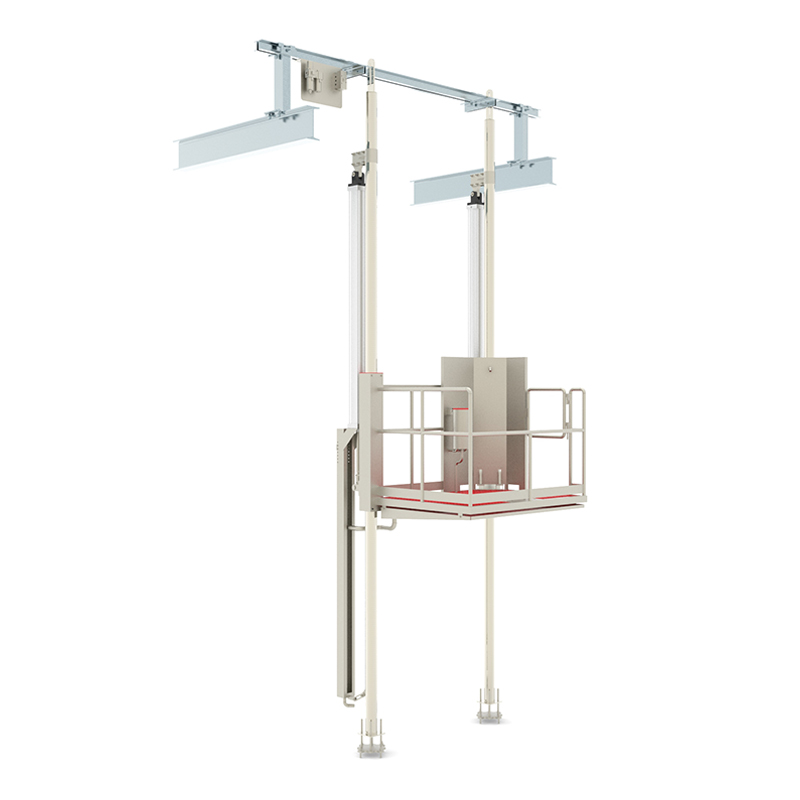
Vertical mast lifts — also called personal lifts, single-person lift platforms, or push-around vertical lifts — are compact, lightweight platforms designed for a single operator performing tasks at moderate heights (typically 4–12 meters) in confined spaces. The platform travels vertically along a single mast or a series of telescoping mast sections, providing a narrow footprint that fits through standard doorways and into aisles, elevator lobbies, and tight interior spaces inaccessible to scissor lifts. Mast lift platforms are walk-behind or self-propelled units used extensively in retail stores, hotels, airports, and commercial buildings for maintenance of lighting, signage, HVAC equipment, and ceiling finishes.
Hydraulic Table Lift Platforms
Hydraulic table lifts — also called stationary hydraulic lifting platforms, lift tables, or scissor table lifts — are fixed or semi-fixed hydraulic platforms used for ergonomic material positioning, loading dock leveling, assembly line height adjustment, and industrial workstation ergonomics applications. Unlike mobile aerial work platforms, hydraulic table lifts are installed at a fixed location and used to raise or lower loads between fixed working heights. They are not designed for personnel elevation in the aerial work platform sense but rather as material handling and ergonomic positioning devices. Platform sizes range from 500 × 500 mm compact units rated at 250 kg to large industrial platforms of 3,000 × 2,000 mm rated at 10,000 kg or more.
Truck-Mounted and Vehicle-Integrated Lift Platforms
Truck-mounted aerial platforms — also called aerial lift trucks, bucket trucks, or elevated work platform vehicles — integrate a boom-mounted work platform onto a commercial truck or van chassis. These platforms are the standard equipment for utility companies performing overhead power line maintenance, telecommunications companies working on elevated cable infrastructure, tree surgeons, and street lighting maintenance teams. The truck chassis provides mobility on public roads, while the onboard outriggers stabilize the vehicle when the platform is deployed. Working heights range from 10 meters for light van-mounted units to over 70 meters for heavy truck-mounted platforms used in transmission line maintenance.
Key Technical Specifications of Lifting Platforms Compared
Comparing lifting platform types on a set of standard technical parameters helps narrow down the right choice for a specific application. The table below provides a structured comparison of the main platform types across the most important selection criteria:
| Platform Type | Typical Working Height | Platform Capacity | Horizontal Reach | Best Application |
| Electric Scissor Lift | 4–14 m | 230–680 kg | Vertical only | Indoor maintenance, warehouses |
| Rough Terrain Scissor | 8–18 m | 450–900 kg | Vertical only | Outdoor construction sites |
| Articulated Boom Lift | 10–26 m | 200–350 kg | Up to 15 m | Confined areas, over obstacles |
| Telescopic Boom Lift | 18–56 m | 230–450 kg | Up to 25 m | High-reach outdoor construction |
| Vertical Mast Lift | 4–12 m | 120–230 kg | Minimal | Confined indoor spaces |
| Hydraulic Table Lift | 0.5–2 m | 500–10,000 kg | None | Material handling, loading docks |
| Truck-Mounted Platform | 10–72 m | 200–400 kg | Up to 30 m | Utility lines, road infrastructure |
Lifting Platform Safety Standards and Regulations
Lifting platform safety is governed by a comprehensive framework of international and regional standards that define design requirements, testing protocols, operator training requirements, and maintenance obligations. Compliance with these standards is not optional — it is mandatory for manufacturers placing lifting equipment on the market and for employers and operators using it on worksites.
Key International and Regional Standards
The primary international standard framework for mobile elevating work platforms (MEWPs) is the ISO 16368 / EN 280 series in Europe and the ANSI/SIA A92 series in North America. ISO 18878 covers operator training requirements. In the European Union, lifting platforms used for personnel must comply with the Machinery Directive 2006/42/EC and carry CE marking, with conformity assessed against EN 280 (mobile elevating work platforms) for aerial work platforms and EN 1570 for scissor lift tables used in material handling. In the UK post-Brexit, PUWER (Provision and Use of Work Equipment Regulations 1998) and LOLER (Lifting Operations and Lifting Equipment Regulations 1998) govern the use, inspection, and maintenance of lifting equipment in the workplace. LOLER specifically requires that all lifting equipment used for lifting persons — including aerial work platforms — undergoes thorough examination by a competent person at least every six months.
Essential Safety Features on Modern Lifting Platforms
Modern hydraulic lift platforms and aerial work platforms incorporate multiple redundant safety systems to protect operators in the event of component failure or operator error. Understanding these systems is important for operators, site managers, and equipment buyers:
- Overload protection: Load sensing systems monitor the platform payload and prevent operation when the rated load is exceeded. On modern scissor lifts and boom lifts, this is typically implemented through hydraulic pressure monitoring or load cells that trigger an alarm and disable lift functions when overload is detected.
- Tilt sensors and automatic leveling: Inclinometers monitor the machine's ground angle and prevent platform elevation or movement when the slope exceeds the manufacturer's safe operating limit — typically 3° for scissor lifts and 5° for boom lifts on firm ground. Some models include automatic outrigger leveling systems that compensate for uneven ground before allowing platform elevation.
- Emergency lowering systems: All personnel lifting platforms must include a means of lowering the platform in the event of power failure or hydraulic system failure. Manual gravity-lowering valves, backup battery-powered lowering systems, and manual hand pump lowering are the common implementations, accessible both from the platform basket and from ground level.
- Fall arrest anchor points: Platforms used for personnel elevation must include certified anchor points for personal fall arrest equipment. Operators working on boom lifts must wear a full-body harness attached to the platform anchor point at all times — EN 280 and ANSI A92 standards specify minimum anchor point load ratings of 6 kN for boom lifts.
- Guardrails and toe boards: Platform decks must be enclosed by guardrails of specified height (minimum 1.1 m in EU standards, 1.07 m in ANSI standards) with mid-rails and toe boards to prevent falls from the platform edge and prevent tools or materials from rolling off the platform onto personnel below.
- Deadman controls and presence sensors: Control systems require the operator to maintain continuous pressure on operating controls — releasing the controls immediately stops all platform movement. Presence sensors on some models detect if the operator has left the platform and automatically restrict certain movements when the platform is unoccupied at height.
How to Select the Right Lifting Platform for Your Application
With so many types and models of work platform lifts available, selection errors are common and can result in equipment that is unsafe, inefficient, or simply unable to perform the required task. Working through the following selection criteria in a logical sequence prevents costly mistakes.
Define the Required Working Height
The working height is the height at which the task must be performed — measured from the ground to the operator's working position, which is typically 1.8 meters above the platform deck (the height of an outstretched arm above a standing person). The platform height — the elevation of the platform deck itself — is therefore 1.8 meters less than the working height. Always specify the highest point at which work must be performed, including any variation in ground elevation across the work area, and select a platform with a working height that exceeds this maximum requirement by at least 0.5 meters to provide a practical margin.
Determine the Required Platform Load Capacity
Platform load capacity must accommodate the total weight of all personnel, tools, and materials that will be on the platform simultaneously at any point during the work. Count the number of workers (each assumed to weigh 100 kg per EN 280), add the weight of all tools and equipment, and apply a safety margin. Never rely on the rated platform capacity as a target to reach — treat it as an absolute limit that must not be approached closer than 80% under normal working conditions to account for dynamic loading from tool use, wind loads, and movement on the platform.
Assess Access and Space Constraints
The available access route to the work area and the space available for machine positioning and operation often determine platform type selection more than any other factor. Measure doorway widths and heights, floor load capacity (particularly important for upper-floor interior work), aisle widths, and overhead clearance in all areas the machine must traverse. For outdoor applications, assess the ground conditions — is the terrain firm and level, or soft and sloped? Does the work area require the machine to pass over soft ground, curbs, ramps, or drainage channels? Confirm whether the work area is accessible only from one side of an obstacle, requiring horizontal reach, or whether the platform can be positioned directly below the work point, allowing a simpler scissor or mast lift to be used.
Choose Between Electric and Engine-Powered Models
Electric (battery-powered) lifting platforms are mandatory for indoor use in occupied buildings due to zero direct emissions and low noise. Battery technology on modern scissor lifts and boom lifts provides adequate range for a full 8-hour shift with typical duty cycles. Engine-powered platforms — diesel, gasoline, or LPG — are needed for heavy outdoor applications where battery range would be insufficient, or where the machine must operate for extended periods away from charging infrastructure. Dual-fuel (engine plus electric hybrid) boom lifts bridge the gap, providing electric-only operation for indoor use and engine operation for outdoor heavy-duty use in the same machine.
Lifting Platform Maintenance: Essential Checks and Service Intervals
A well-maintained aerial work platform performs reliably and safely throughout its service life; a neglected one becomes a serious hazard. Maintenance requirements for lifting platforms fall into three categories: pre-use checks performed by the operator before every shift, periodic maintenance performed by qualified technicians at defined intervals, and statutory thorough examination performed by an independent competent person.
- Pre-use operator checks (daily/each shift): Inspect the platform deck, guardrails, toe boards, and entry gate for damage. Check all control functions from both platform and ground control stations. Verify that emergency lowering operates correctly. Check hydraulic fluid level and inspect visible hoses for leaks or damage. Check tire condition and inflation (pneumatic tires). Verify battery charge level (electric models). Check that all safety labels and load rating placards are legible. Record the inspection and do not operate the machine if any defect is found.
- Periodic preventive maintenance (every 250–500 operating hours or annually): Change hydraulic oil and filters. Lubricate all pivot points, scissor pins, and boom joints. Inspect and torque all structural fasteners. Test and calibrate overload protection, tilt sensors, and limit switches. Test emergency descent systems. Inspect battery condition and charge capacity (electric models). Service the drive motors and transmission. Check cylinder seals and replace if leaking. Inspect structural welds for cracking, particularly at scissor arm pivot points and boom root joints.
- Statutory thorough examination (every 6 months for personnel lifts under LOLER): An independent competent person — typically a qualified engineer employed by an accredited inspection body — performs a detailed physical examination of the entire machine, tests all safety-critical functions, reviews the maintenance records, and issues a written examination report. If the examination identifies defects that affect safety, the machine must be taken out of service until the defects are rectified and re-examined. The examination report must be retained for the life of the machine.
Operator Training and Certification Requirements
Operating a lifting platform — whether a scissor lift, boom lift, or mast lift — requires specific training and, in most jurisdictions, formal certification. The ISO 18878 international standard and its regional equivalents define the minimum training content for MEWP operators. In the UK, the IPAF (International Powered Access Federation) operator card scheme is the widely recognized industry qualification. In the US and Canada, ANSI/SIA A92.22 establishes operator training requirements. European operators typically require training aligned with EN 280 requirements, often delivered through national industry associations.
Effective operator training covers the operating principles and controls of the specific platform category, pre-use inspection procedures, safe working practices including exclusion zones and ground conditions assessment, emergency procedures including self-rescue and assisted rescue from height, relevant regulations and operator responsibilities, and practical operation of the machine type under supervised conditions. Training should be renewed at intervals — typically every three to five years — and refresher training is required when an operator switches to a significantly different platform type, such as moving from scissor lift operation to articulated boom lift operation.
Employers are legally responsible for ensuring that only trained and authorized personnel operate lifting platforms in their workplaces. Permitting an untrained person to operate a lifting platform — even temporarily or in an emergency — creates serious legal liability and, more importantly, significantly increases the risk of a fatal or serious injury accident. Investing in proper operator training and maintaining current certification records for all platform operators is both a legal obligation and a fundamental duty of care.
Buying vs. Renting a Lifting Platform: How to Decide
One of the most common practical decisions facing businesses that need lifting platform capability is whether to purchase equipment outright or rent it for specific projects. The right answer depends on the frequency of use, the variety of platform types needed, the budget available for capital equipment versus operating expenses, and the availability of in-house maintenance capability.
- Rental is typically better when: Platform use is infrequent — fewer than 60–80 days per year for a single unit. A variety of platform types and sizes are needed across different projects. The latest equipment with current safety features is preferred without capital investment. Maintenance, inspection, and compliance management should be handled by the rental provider. The work involves a single project or short-term contract.
- Purchasing is typically better when: Platform use is frequent — more than 80–100 days per year for a single consistent platform type. The same platform type is used repeatedly for routine maintenance operations. Long-term total cost of ownership is lower than cumulative rental costs — typically achieved within 3–5 years of consistent use. In-house maintenance capability exists or can be developed. Custom platform specifications or branding are required. The platform represents a core business asset for a specialist contractor.
- Lease financing bridges both options: Operating lease and finance lease arrangements allow businesses to use a specific platform for a defined period (typically 3–5 years) with fixed monthly payments, without the full capital outlay of purchase. At lease end, the equipment can be returned, upgraded, or purchased at residual value. Leasing provides cost predictability, access to current models, and avoids the residual value risk of ownership while providing more consistent platform availability than rental.
When evaluating lifting platform suppliers — whether for rental, purchase, or lease — consider the proximity and response time of their service network, the availability and pricing of spare parts, the quality and currency of their equipment fleet, their training and operator support services, and their track record of compliance with statutory inspection obligations. A platform that is unavailable due to poor service support costs far more in lost productivity than the initial price saving from choosing a cheaper supplier.