

 English
 русский
 Español
 عربى
عربى
Suppose your meat processing plant has just outgrown its current batch smoker. You start comparing commercial smokehouses and quickly realise that published specifications tell only part of the story. Chamber volume, heating capacity and maximum temperature all matter, but the real performance test is whether the unit can repeat the same colour, flavour and texture load after load. This guide walks through the decisions that affect that outcome, beginning with airflow design and ending with cleaning and safety. If you need a quick selection checklist before going deeper, our commercial smokehouse selection guide covers the essential points.
Content
What a Commercial Smokehouse Actually Does
A commercial smokehouse is a precision environmental chamber, not simply a large oven. It controls four variables at once: temperature, humidity, airflow velocity and smoke density. During a typical smoked sausage cycle, the unit first dries the casing surface, then deposits smoke onto the product, cooks the centre to a set core temperature, and finally cools the batch before chilling. Each phase demands a different condition inside the chamber, and the speed with which the unit can switch between phases is one of the main differences between average and outstanding equipment.
This also explains why buying purely on price or physical dimensions is risky. A 2,000 kg capacity smokehouse with poor humidity control can produce soggy casings on Monday and cracked surfaces on Tuesday, while a well-controlled 1,500 kg unit will give you consistency. Put the process requirements first, then match the hardware to them.
Airflow Design: The Science of Uniformity
The first decision you face is the airflow configuration. It determines how evenly treated the product will be, and how much you can load without creating cold spots. Horizontal airflow pushes air from one side of the chamber to the other, which suits hanging products like sausages and bacon. Vertical airflow moves air from top to bottom and works best with tray-loaded products such as fish fillets or flattened cuts. Variable airflow allows the operator to change the direction for longer product lines or varied batch configurations.
| Airflow Type | Path | Best Applications | Watchout |
|---|---|---|---|
| Horizontal | Side to side | Hanging sausages, bacon strips | May need fan speed adjustment for dense loads |
| Vertical | Top to bottom | Tray-loaded fish, small cuts | Rack spacing affects uniformity |
| Variable | Switching | Diverse product mix, R&D | More complex control logic |
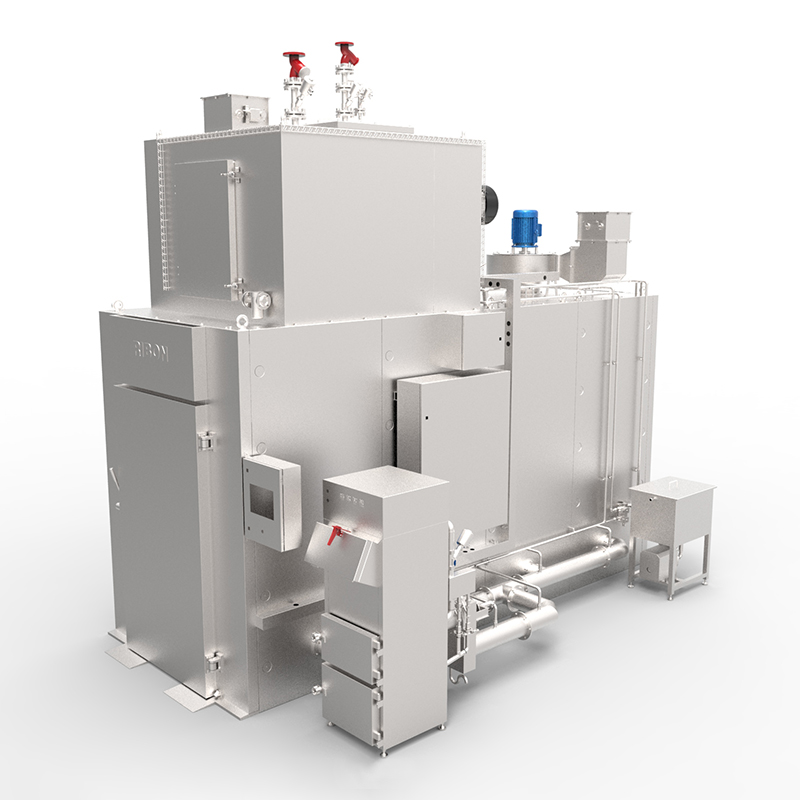
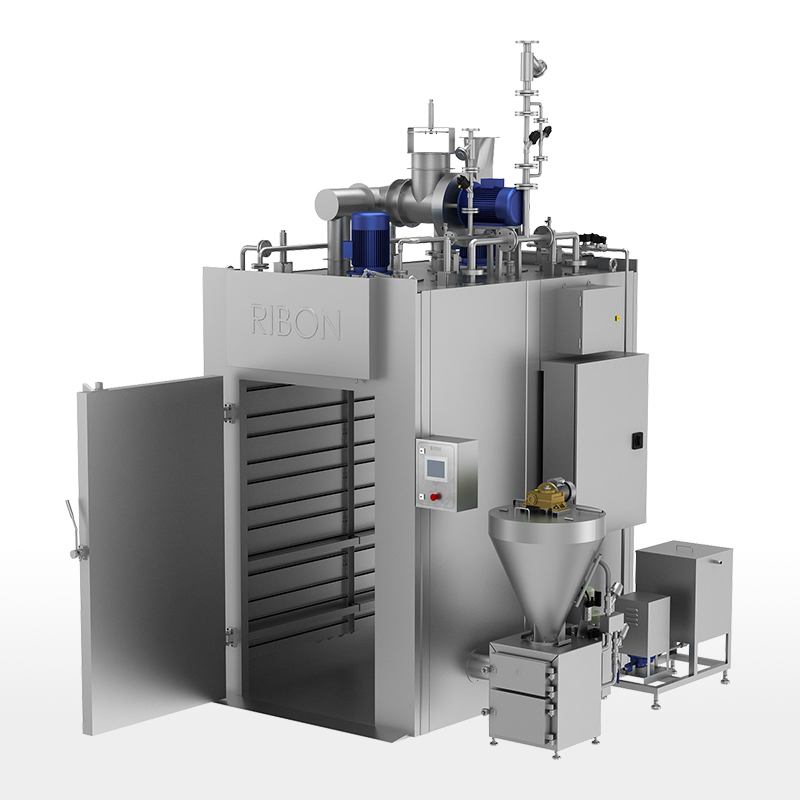
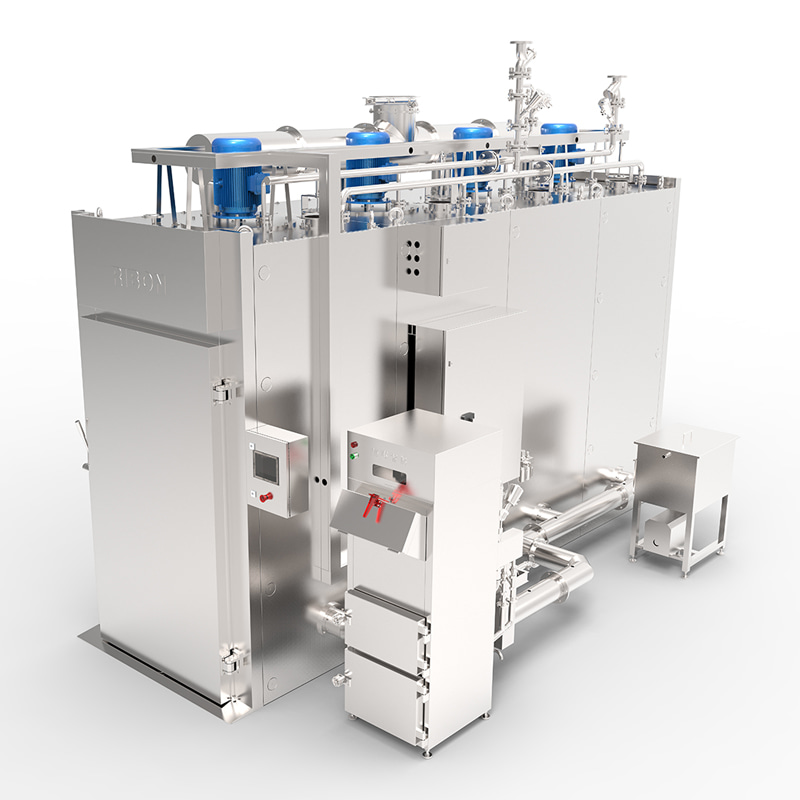
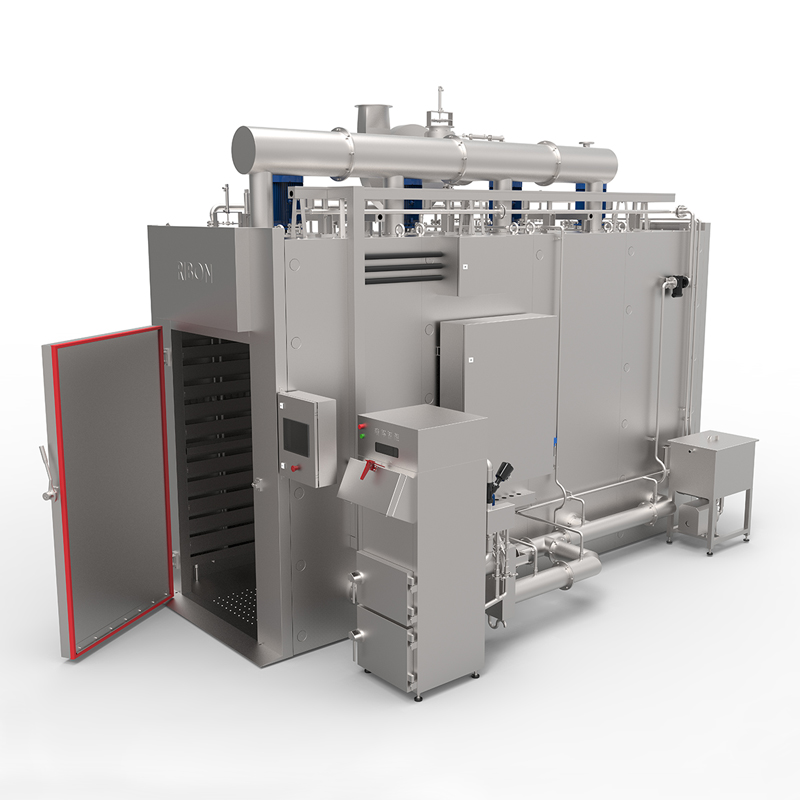
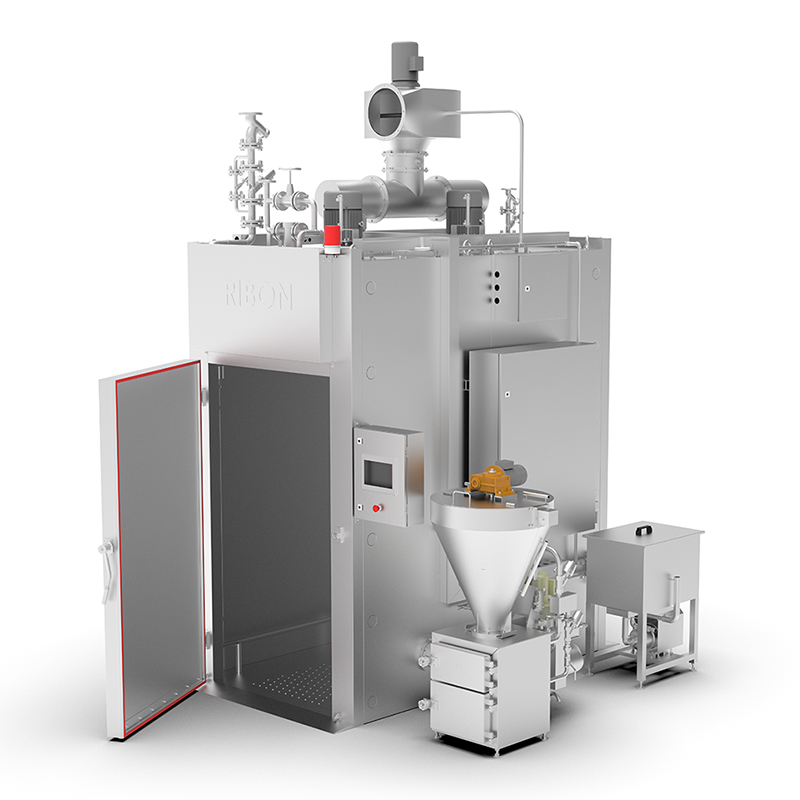 Variable Airflow Smokehouse for Hanging and Tray ProductsThis smokehouse offers three airflow modes to handle both hanging and tray-loaded items. It suits plants expanding product lines, with frequency inverter and RUN-FLOW technology for even temperature and humidity. Useful for pet food drying too.View Product →
In practice, a variable airflow smokehouse is a safe investment when your product range will expand. If you are sure that only one type of product will run for the next several years, a dedicated horizontal or vertical unit is simpler and more economical. But for a plant that supplies retail, food service and private label, the ability to reconfigure airflow is a real asset. Make sure the control software lets you store airflow direction as part of each recipe, so the change is automatic rather than a manual step.
Capacity Planning: More Than Chamber Volume
Capacity is usually the first number buyers look at, but it is also the easiest to misread. The nameplate volume is not the same as usable volume. Air needs space to circulate around each piece of meat; if you cram the chamber to its geometric maximum, temperature and smoke distribution become uneven. Instead of asking “How many kilograms does it hold?”, calculate batch size from the effective rack area or hanging rod length and your recommended loading density per square metre or rod.
For a hot-smoked product, allow more space between pieces than for cold smoking, because hot smoke processes often include a cooking phase where the product expands. Also, consider your daily batches, not just one batch size. Two smaller units can maintain production when one is in cleaning or maintenance, while a single large unit brings the whole line to a stop. Many experienced processors deliberately build lines with two or three 1,000 kg units rather than one 3,000 kg smokehouse.
Smoke Generation: Wood Chip, Liquid Smoke, and Consistency
Smoke comes from either traditionally burnt wood chips or liquid smoke applied as an atomised mist or by drenching. Conventional wood-chip smoke generators are popular for their authentic round flavour, but they require careful handling of chip moisture, combustion air and ash. Liquid smoke systems, on the other hand, deliver a repeatable smoke profile with less cleaning and a lower fire risk. That makes them attractive for high-throughput or multi-shift production where consistency matters more than batch-by-batch variations.
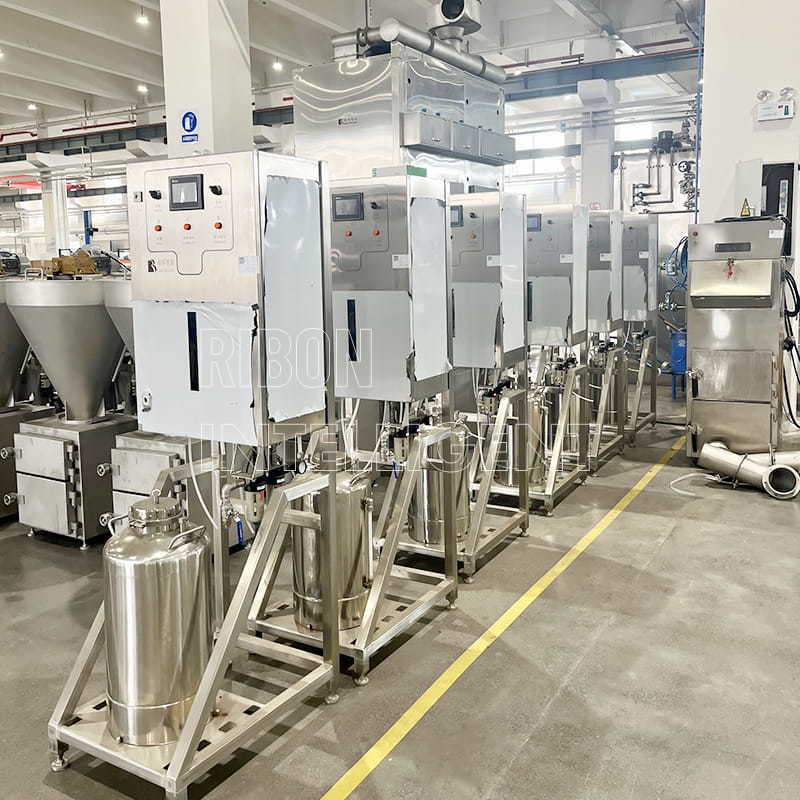 Liquid Smoke Atomizer for Consistent Smoking and SafetyThis atomizer provides repeatable smoke profiles while reducing carcinogen risk, cleaning time, and fire hazards. It speeds up smoking and ensures uniform color, making it ideal for high-throughput or multi-shift production needing consistency.View Product →
If you are launching a new product line, do not underestimate the time needed to fine-tune smoke input. An atomiser that sprays liquid smoke into the airflow can produce uniform colour on a dense load in minutes, whereas a wood-chip generator may need longer and is more sensitive to the type of wood. Smart plants often install both: a wood-chip unit for signature smoked products, and a liquid-smoke unit for large volumes of standard goods. Whichever method you choose, insist on a system that controls smoke density in direct relation to chamber airflow, not just a timer.
Controls and Repeatability
For most commercial meat processors, the control system has become more important than the physical components. A modern smokehouse controller should let the operator upload a cooking and smoking schedule with set points for temperature, humidity, smoke density, air velocity and process time. It should also record actual measured values for every batch, which is essential for food safety audits and for refining your recipes.
Look for at least two core temperature probes and a shuttle probe for the air temperature, so the controller can regulate both product and chamber conditions. If you run multiple smokehouses, consider a central data collection system that lets one supervisor watch all units from a single screen. This is not a luxury; it is how you turn recipes into repeatable products and identify problems before they affect a whole batch.
Hot Smoking vs. Cold Smoking
Hot smoking cooks the product while it picks up smoke, usually in the temperature range of 50 to 90°C. Cold smoking is done below 30°C and is used for products like salmon, cheese and certain hams, where you want smoke flavour without cooking the muscle. The two processes demand different hardware behaviour. A hot smokehouse needs strong heating and fast steam cooking, while a cold smokehouse needs gentle airflow and a smoke source that can produce a large volume of smoke at low temperature without creating excessive condensation.
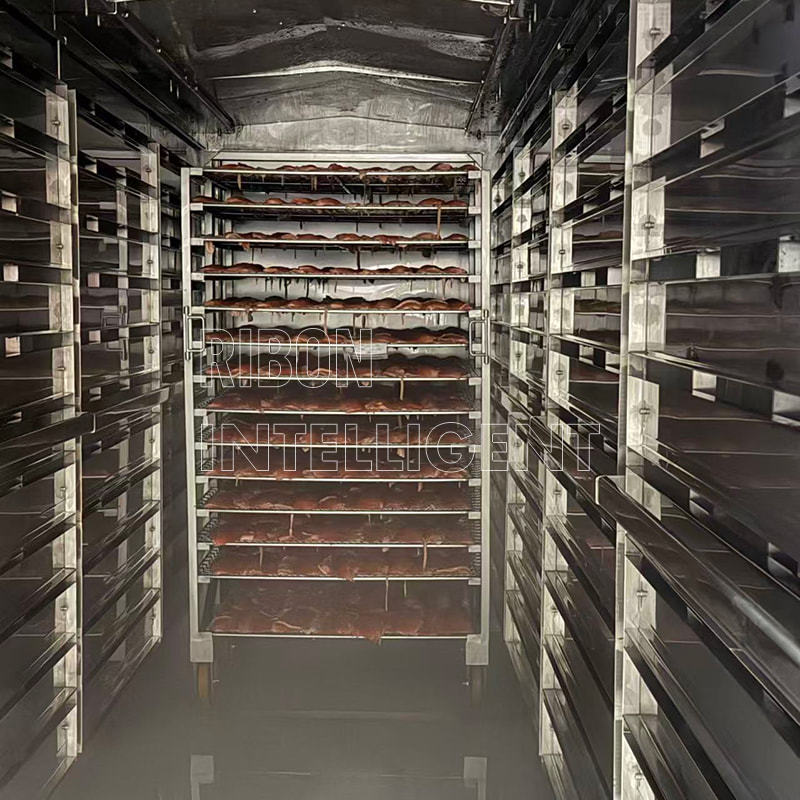 Cold Smoking Smokehouse for Low-Temperature ProcessingDesigned for smoking below 30°C, this unit enables slow drying, ripening, and even coloring for products like salmon and cheese. It features insulated walls, precise humidity control, and optional liquid smoke atomizer, ensuring safe and efficient cold smoking.View Product →
If you plan to do both, you have two options. First, buy a hot smokehouse with a cold-smoking programme and an external smoke generator; this works for occasional cold smoking. Second, use a dedicated cold smoker for the cold products and a separate hot smoker for cooked products. The second option gives you better process control and flexibility, but costs more. Ask your supplier to show you temperature uniformity data at both ends of the range. A unit that performs well at 75°C may struggle to hold 25°C on a hot summer day.
Designing for Cleaning and Safety
Finally, think about what happens between production shifts. Smokehouse interiors accumulate flammable resins, greasy films and odour residue. If you ignore cleaning, smoke circulation becomes uneven and the fire risk rises. Choose equipment with smooth, round-cornered chambers, removable smoke duct covers and a drainage system that lets you flush the interior quickly. Stainless steel with a suitable surface finish is the industry baseline, but the exact grade and welding quality matter more on vertical surfaces and around inspection doors.
Create a cleaning schedule based on the number of shifts and the type of smoking. A basic routine includes:
- Daily brushing of racks and internal walls to remove loose ash and residues.
- Weekly washing of the chamber, fans and smoke duct with approved cleaning agents.
- Monthly inspection of heating elements, temperature sensors and door seals.
- Periodic service of the smoke generator and condensate drainage by the manufacturer's technician.
Make sure the supplier you work with offers responsive technical service and spare parts. A commercial smokehouse is a long-term asset, and the quality of that relationship is as important as the equipment itself.
In summary, the right commercial smokehouse is the one that can maintain the exact processing environment your product requires, batch after batch. Do not let a big chamber volume or a low price override the fundamentals of airflow, smoke control, washability and after-sales support. Before you commit, ask for a test run with your own product. A manufacturer with a complete testing facility, such as the central test centre at Ribon, lets you validate process parameters before the equipment ships. That practical step will save you months of trial-and-error after installation and give you confidence that your investment will pay off in the form of consistent, high-quality smoked products.